
For many Filipinos, teaching is more than just a profession—it is a lifelong commitment to shaping the country’s future. However, as inflation, living expenses, and economic pressures continue to rise, salary and financial stability have become increasingly important concerns for educators across the Philippines.
As the government moves toward the continued implementation of the Salary Standardization Law VI (SSL 6), many public school teachers are closely monitoring the projected DepEd teachers salary 2026 structure, expected salary increases, allowances, and take-home pay adjustments.
Whether you are an aspiring teacher, a newly hired educator, or a long-time public school professional planning your career progression, understanding the latest DepEd salary structure is essential for financial planning and career growth.
This complete guide covers:
- DepEd teacher salary grades for 2026
- SSL 6 salary increase projections
- Teacher I to Master Teacher salary estimates
- Bonuses and allowances
- Net take-home pay computation
- GSIS, PhilHealth, and Pag-IBIG deductions
- Career progression and salary upgrades
What Is the DepEd Teachers Salary Structure in 2026?
Public school teachers in the Philippines follow the government compensation framework established under the Salary Standardization Law (SSL).
Under the projected SSL 6 implementation, public school educators are expected to receive gradual salary increases designed to help government employees keep up with inflation and rising living costs.
A teacher’s compensation depends primarily on:
- Salary Grade (SG)
- Step Increment
- Position level
- Years of service
- Reclassification status
- Allowances and bonuses
For most entry-level educators, the starting point remains Teacher I under Salary Grade 11.
DepEd Teacher Salary Grade Table 2026
Below is the projected DepEd teachers salary grade structure for 2026 based on current government compensation trends and SSL 6 projections.
| Position | Salary Grade | Estimated Monthly Salary (2026) |
|---|---|---|
| Teacher I | SG 11 | PHP 30,000 – PHP 31,000 |
| Teacher II | SG 12 | PHP 32,000 – PHP 34,000 |
| Teacher III | SG 13 | PHP 35,000 – PHP 37,000 |
| Master Teacher I | SG 18 | PHP 49,000 – PHP 51,000 |
| Master Teacher II | SG 19 | PHP 55,000 – PHP 57,000 |
| Master Teacher III | SG 20 | PHP 61,000 – PHP 63,000 |
| Principal I | SG 19 | PHP 55,000 – PHP 57,000 |
Actual salaries may vary depending on SSL 6 tranche implementation, step increments, and government budget approvals.
Teacher I Salary in 2026
Teacher I remains the standard entry-level position for newly hired public school educators.
Under the projected Salary Grade 11 basic pay structure, Teacher I salaries in 2026 are expected to become more competitive compared to previous years.
For many fresh graduates entering public service, the Teacher I position offers:
- Stable monthly income
- Government-backed benefits
- Clear career progression
- Step increment increases
- Long-term retirement security
Compared to many private schools in the Philippines, DepEd often provides stronger compensation packages for entry-level teachers.
Salary Standardization Law VI (SSL 6) Explained
The Salary Standardization Law (SSL) is the government framework responsible for adjusting compensation rates for public sector employees.
SSL 6 is expected to continue improving government salary competitiveness through phased wage increases across multiple years.
For teachers, SSL 6 may impact:
- Monthly salary increases
- Salary grade adjustments
- Allowance improvements
- Net take-home pay
- Retirement contribution amounts
Many educators are closely monitoring official announcements from:
- Department of Budget and Management (DBM)
- Department of Education (DepEd)
- Civil Service Commission (CSC)
These agencies typically release updated salary tranche schedules and compensation circulars.
Public vs Private School Teacher Salary Comparison
One of the most common questions among education graduates is whether public or private school teaching offers better compensation.
Public School Teacher Salaries
Public school teachers generally receive:
- Higher entry-level salaries
- Government bonuses
- Stronger job security
- GSIS retirement benefits
- Standardized salary increases
- Additional statutory allowances
Private School Teacher Salaries
Private school compensation varies significantly depending on the institution.
Elite international schools and major universities may offer premium salaries, but many standard private schools still struggle to match DepEd compensation packages for entry-level educators.
For long-term financial stability, many teachers still prefer public school employment.
Allowances and Benefits for DepEd Teachers
Teacher compensation goes beyond basic salary.
Public school educators receive multiple allowances and statutory benefits that significantly improve annual income.
Magna Carta Benefits for Public School Teachers
The Magna Carta for Public School Teachers protects educator welfare and provides additional compensation benefits.
Eligible teachers may receive:
- Special hardship allowances
- Overtime compensation
- Hazard pay
- Transfer protection
- Reduced excessive teaching load risks
Teachers assigned to remote or difficult locations may qualify for additional financial support.
Teaching Supplies Allowance
Previously known as the “chalk allowance,” the teaching supplies allowance helps teachers purchase:
- Classroom materials
- Visual aids
- Internet load
- Educational resources
- Printing supplies
As digital learning continues to expand, this allowance has become increasingly important for educators.
Clothing Allowance
DepEd also provides annual clothing allowances to help teachers maintain professional uniforms and work attire.
Although relatively small compared to basic pay, this benefit still contributes to overall compensation value.
Bonuses and Incentives for DepEd Teachers
One of the biggest advantages of public school employment is the predictable bonus structure.
These bonuses significantly increase annual earnings.
Mid-Year Bonus
The Mid-Year Bonus is typically equivalent to one month of the teacher’s basic salary.
Teachers generally receive this incentive around May, provided they meet required service conditions.
This bonus often helps educators prepare financially for the opening of classes.
Year-End Bonus and Cash Gift
Public school teachers may also receive:
- Year-end bonuses
- Additional government cash gifts
Eligibility usually requires:
- At least four months of service
- Continued active service by October 31
Holiday bonuses are one of the most anticipated financial benefits for government employees.
Performance-Based Bonus (PBB)
The Performance-Based Bonus rewards teachers and schools that meet operational and performance targets.
PBB computation may depend on:
- School performance ratings
- Individual IPCRF ratings
- Departmental performance metrics
- Government evaluation standards
High-performing educators may receive significantly larger incentive payouts.

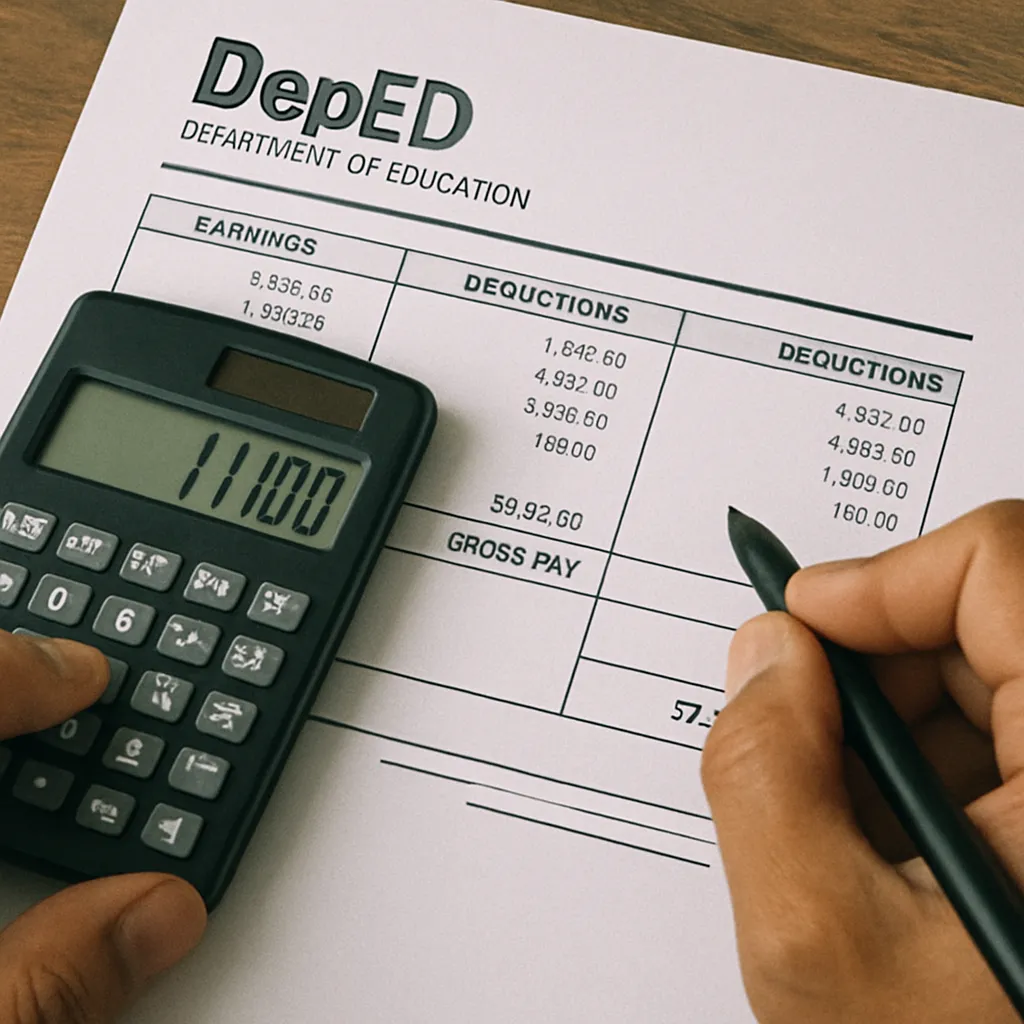
Understanding DepEd Payslip Deductions
Although gross salary figures appear attractive, teachers must understand mandatory deductions to accurately estimate monthly take-home pay.
GSIS Contributions
The Government Service Insurance System (GSIS) provides:
- Retirement benefits
- Insurance coverage
- Salary loans
- Emergency loans
Monthly contributions are automatically deducted from teacher salaries.
PhilHealth Contributions
PhilHealth deductions help provide healthcare and hospitalization support for teachers and their dependents.
Contribution rates may vary depending on salary adjustments.
Pag-IBIG Contributions
Pag-IBIG serves as both a savings and housing support program.
Teachers may access:
- Housing loans
- Multi-purpose loans
- Savings dividends
Pag-IBIG remains one of the most important long-term financial support systems for government employees.
How to Compute DepEd Net Take-Home Pay
To estimate your actual monthly salary, follow this simple process.
Step 1: Identify Your Gross Basic Salary
Start with your official Salary Grade basic pay.
Step 2: Add Fixed Allowances
Include allowances such as:
- PERA
- Teaching supplies allowance
- Other recurring benefits
Step 3: Subtract Mandatory Deductions
Deduct:
- GSIS
- PhilHealth
- Pag-IBIG
- Withholding tax
Step 4: Deduct Existing Loans
Subtract any:
- GSIS loans
- Pag-IBIG loans
- Salary loan amortizations
Step 5: Calculate Remaining Balance
The remaining amount becomes your estimated net take-home pay.
DepEd also implements Net Take-Home Pay (NTHP) policies to prevent excessive over-borrowing among teachers.
Career Growth and Salary Progression
One of the strongest advantages of public school teaching is structured career progression.
Teachers have multiple opportunities to increase compensation throughout their careers.
Teacher Reclassification and Salary Adjustment
Educators who complete advanced degrees or meet promotion standards may apply for reclassification.
This process may upgrade positions such as:
- Teacher I to Teacher II
- Teacher II to Teacher III
- Teacher III to Master Teacher
Reclassification typically results in permanent salary grade increases.
Step Increments for Length of Service
Even without promotion, teachers may still receive salary increases through step increments.
Teachers generally move one step higher within their salary grade every three years of continuous satisfactory service.
Because each salary grade contains multiple steps, educators can steadily improve compensation over time.
Why Public School Teaching Remains Financially Competitive
Despite ongoing economic challenges, public school teaching remains one of the most financially stable professions in the Philippines.
Key advantages include:
- Predictable salary growth
- Government-backed retirement systems
- Structured bonuses
- Stable employment
- Long-term career progression
- Strong statutory benefits
For many Filipino educators, these benefits provide greater financial security compared to private sector teaching opportunities.
Frequently Asked Questions
What is the salary of Teacher I in 2026?
Teacher I under Salary Grade 11 is projected to earn around PHP 30,000 to PHP 31,000 monthly in 2026, depending on SSL 6 implementation.
Will DepEd teachers receive salary increases in 2026?
Projected SSL 6 implementation may continue increasing public school teacher salaries through phased adjustments.
What allowances do DepEd teachers receive?
Teachers may receive teaching supplies allowances, clothing allowances, hardship allowances, PERA, bonuses, and other statutory benefits.
What is SSL 6?
SSL 6 refers to the proposed Salary Standardization Law VI, which aims to improve government employee compensation through scheduled salary increases.
How do teachers compute net take-home pay?
Teachers subtract GSIS, PhilHealth, Pag-IBIG, taxes, and loan deductions from gross salary plus allowances to estimate take-home pay.
Final Thoughts
The projected DepEd teachers salary 2026 structure offers promising improvements for educators across the Philippines.
With ongoing SSL 6 implementation, salary grade progression, government allowances, and long-term retirement benefits, public school teaching continues to provide one of the most stable and rewarding career paths in the country.
By understanding salary grades, deductions, bonuses, and career advancement opportunities, teachers can make smarter financial decisions while building sustainable long-term careers in education.
Looking for Teaching Jobs in the Philippines?
Explore the latest teaching opportunities, education careers, and public school job openings through Bossjob and discover new ways to grow your professional teaching career.


