
Separation pay is one of the rights of workers in the Philippines. It serves as financial assistance during the time between jobs. It is one of the essential components of the social safety net as well. The guide will assist in knowing what you are entitled to. It describes the calculation of the payment. It also informs you of what to be wary of when this money comes into your hands.
What is Separation Pay in the Philippines?
Separation pay is a financial reward, which is required to be paid following the Labor Code of the Philippines (PD No. 442, as amended) to the employees whose employment terminates due to certain conditions. It gives monetary compensation in the transitional period of involuntary termination.
Separation pay Philippines is a requirement of law for employers, and it minimises labour disputes. To the employees, it is an insurance factor that pays them when their income is unexpectedly cut as they go out to find new employment. It will be given within the law, immediately, depending on the tenure, last salary, and the cause of termination.
Who is Entitled to Separation Pay Philippines?
Applicable to:
- Employees terminated due to authorised causes under the Labour Code.
- Employees were separated because of the company closure, not due to serious business losses.
- Affected employees are subject to redundancy or retrenchment.
- Employees were terminated due to the installation of labour-saving devices.
Not Applicable to:
- There are employees who were fired due to just causes (misconduct, neglect, fraud, etc.).
- Voluntary resigning employees.
- Workers whose parting is amicably agreed and has no legal foundation.
- Seasonal or project-based workers who fulfil their engagement (except when it is stated otherwise by company policy).
Separation Pay vs Severance Pay
The terms “separation pay” and “severance pay” are often used interchangeably, but they have distinct legal meanings in the Philippine context.
| Feature | Separation Pay | Severance Pay |
|---|---|---|
| Legal Basis | Mandated by the Philippine Labor Code. | Typically based on company policy, collective bargaining agreements (CBA), or individual contracts. |
| Coverage | Paid for authorized causes of termination (e.g., retrenchment, disease). | Often paid for a wider range of separations, potentially including voluntary resignations as a “gratuity.” |
| Entitlement | A legal right for qualified employees. | A contractual or discretionary benefit, not a statutory right. |
| Calculation | Usually follows a formula set by law (e.g., at least 1 month pay per year of service). | Defined by the specific policy or contract, which may be more or less generous than the legal requirement. |
In essence, separation pay is a legal obligation, whereas severance pay is contractually guaranteed.
Two Types of Separation Pay
Separation pay is mainly applicable in two broad areas, namely retrenchment and other involuntary separations. The purpose is the determining consideration in the application, and even the calculation.

Retrenchment Separation Pay
This is paid in case a firm downsizes its employees. This is done to prevent huge losses of money. At least one month’s pay is given to the employee. Or, they receive half a year’s pay every year of service. They will receive the highest of the two. This compensation assists the employees in recovering quickly when the organisation is forced to reorganise.
Involuntary Separation Pay
This is in the case where the employer terminates the job on other acceptable grounds. As an example, in case the business closes, but not due to excessive losses. It is also applicable in case a worker is sick. In such a case, separation pay is received by the employee. This compensation is one month’s salary at least. Or, it is half a month’s pay for a year of service. The employee is paid the better of the two amounts.
How to Compute Separation Pay in the Philippines?
Separation pay computation is quite different based on the nature of employment separation. This is because it is important to establish the right scenario in order to arrive at the right formula.
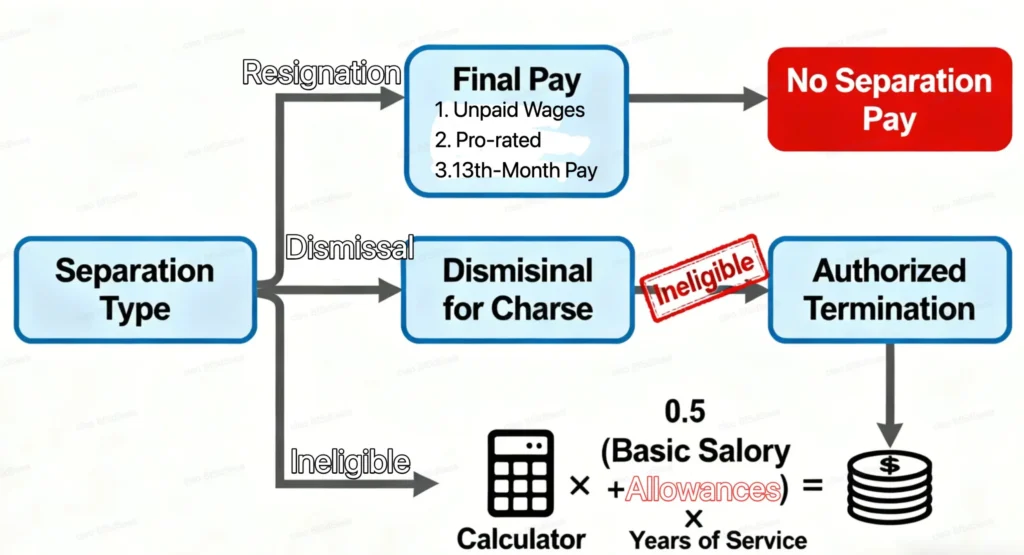
Separation Pay for Resigned Employee
Workers who voluntarily leave the company usually do not get separation pay. The amount of their last remuneration will generally be based on any unpaid wages, proportional 13th-month pay and any outstanding leave credits (assuming the company policy permits it to be monetised).
Separation Pay for Terminated Employee
This depends on the cause of termination.
- For Just Causes (e.g., gross negligence): No separation pay is given.
- For Authorised Causes (e.g., retrenchment, redundancy): The standard formula is at least one-half (1/2) month’s pay for every year of service. A month’s pay is often calculated as (Basic Salary + Regular Allowances).
Separation Pay for Retired Employees
In the case of employees who are retiring within the compulsory retirement age of 65 or the optional retirement age of 60 (assuming that he or she has served at least 5 years in the company), any retirement pay that is provided by the employer is in lieu of separation pay. This is normally controlled by the retirement plan of the company, CBA, or the minimum of one-half monthly salary per year worked set out by the Labour code.
Discover Next Ideal Jobs on Bossjob
On Bossjob, you can connect directly with top employers in the Philippines.
How Much Do You Get for Separation Pay?
Separation compensation is usually a half-month to one month of annual pay based on the cause of separation and corporate regulations.
- Length of Service: This is the most important factor. The more years of service you have with the company, the larger your separation pay will be since it is calculated on a basis of per year of service.
- Basic Salary: The basic salary is the first figure to be considered in the calculation. Greater compensation means greater separation compensation.
- Reason of Separation: As stated earlier, the legal reason for terminating a job (authorised cause or just cause) is the main force that determines what the individual can receive. It has the ability to alter the calculation of the final payment, too.
- Company Policy or CBA: Certain employers do have their own rules or a union contract. These are capable of being better than the law dictates. As an illustration, they may pay one month’s salary per annum of service with an employee. Other benefits may also be provided by them.
Conclusion
Labour Code of the Philippines separation pay is not only a legal protection to the employer, but also an imperative financial insurance to the employee in the process of a job change. Knowing this right will enable you to make a transition into your career with a lot of confidence.
And you are ready to take your next chance? Register on bossjob and start your search today, and take a step in your professional journey.
FAQs
What pay do I get when I resign?
When you resign, you are entitled to your final pay, which includes any unpaid salary, monetised unused leave credits, and a proportional 13th-month pay. You do not typically receive separation pay.
Does my employer have to pay me if I quit?
Yes, your employer is legally obligated to release your final pay, which consists of unpaid wages and other accrued benefits, but not separation pay.
How long should I wait for my final pay?
There is no set deadline stipulated in the law, although the Department of Labour and Employment (DOLE) recommends that it must be published within a justifiable period, usually within a span of 30 days after your last day. There are certain company policies in which a shorter period is given.
Is separation pay taxable?
The answer to this is no, separation pay as a result of retrenchment, redundancy, illness, or some other valid reason is usually tax-exempt, so long as it is not over the legal limit.


