
The Philippines has created an active work and labour climate with the aid of a youthful, English-skilled workforce, low labour costs, and well-perceived IT and BPO sectors.
With the trend of domestic and international employment on the rise, both in remote working and across online hiring practices, the labor market in the country is expanding to greater levels of internationalization, providing extensive access to both domestic and international skills.
The article presents a methodical discourse on the current and predicted average salary in the Philippines in the near future, and important factors and trends in the salary level, and provides clear insights for employers and employees.
How Much is the Average Salary in the Philippines?
According to combined data from PSA 2025, average wages in the Philippines (nationwide) have changed significantly in recent years, showing an overall trend of recovery and growth.
2025-2025 Average Salary Philippines:
- 2020: ~PHP 13,500/month | ~PHP 162,000/year
- 2021: ~PHP 14,000/month | ~PHP 168,000/year
- 2022: ~PHP 15,200/month | ~PHP 182,400/year
- 2023: ~PHP 16,500/month | ~PHP 198,000/year
- 2024: ~PHP 17,800/month | ~PHP 213,600/year
- 2025: ~PHP 19,200/month | ~PHP 230,400/year
Economic Growth and Inflation Impact
As can be seen in the figure, the average salary in the Philippines started to recover in late 2021 after the pandemic shock, and in 2022-2023, rates of increase in nominal wages are higher due to the opening up of the economy and the level of high inflation. From 2024 onward, easing inflation and stronger economic fundamentals have supported a shift toward more stable, real wage growth.
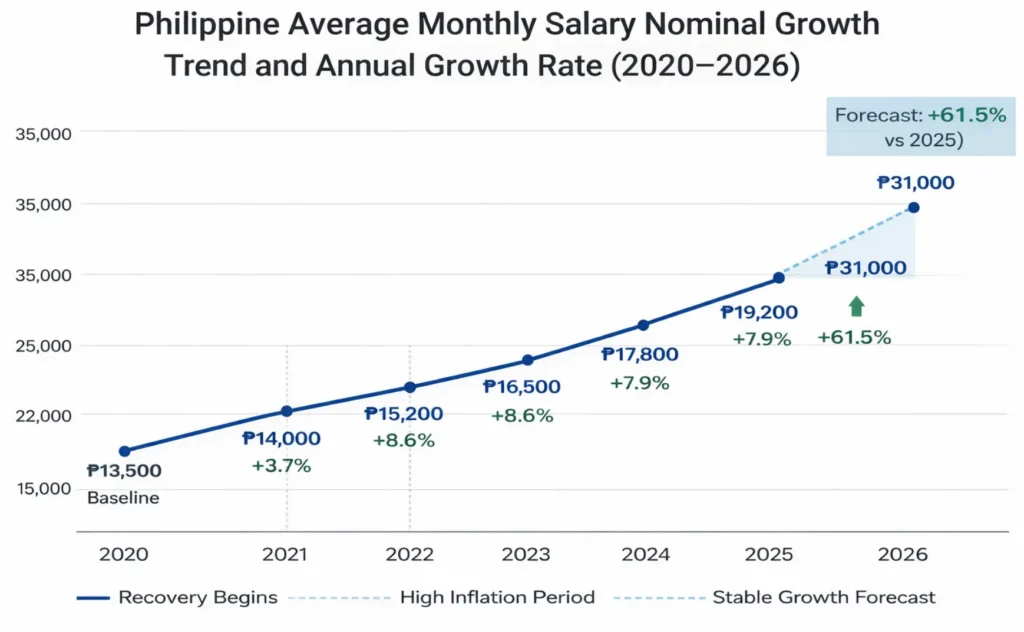
According to the estimated GDP growth, inflation, and the continuum of labor demand, mainly in technology and services, the average wages per month will increase to around ₱31,000-37,000 per year in 2026.
In the future, it is anticipated that salary increases will be dependent on economic stability and productivity increases, as opposed to adjustments based on inflation increases.
High-skilled positions attract incomes that are very high compared to the national average. The business sectors that have been exhibiting high demand include IT, BPO, finance, healthcare, and engineering. Low-skill and routine service jobs, on the contrary, are closer to minimum or median salaries.
In general, the most significant factors of average salary in the Philippines differentiation are education level, technical skills, and experience in this industry.
Remote Work and Global Hiring Trends
Remote work has completely transformed the Philippine employment situation.

- To the job seekers: Widened outreach to international employers and greater earning capacity.
- To employers: Filipino talent is cheaper, speaks English, and fits time zone-wise, hence making Filipino talent a dream source of remote team members or cross-border team members.
Nonetheless, cross-border recruitment is usually associated with difficulties in screening, matching, and compliance of the candidates.
Bossjob is determined to alter the inefficiencies and communication barriers embedded within the conventional recruitment models. It provides an online direct chat feature, an optimized recruitment process, minimizes the time spent on communication, and enables recruitment to be efficient.
Average Salary in the Philippines by Industries
Salary levels vary significantly across different industries in the Philippines, primarily due to the industry’s capital intensity, technological barriers, internationalization, and profit margins.
| Industry | Industry Characteristics | 2025 Avg. Salary (PHP/month) | 2026 Forecast (PHP/month) |
|---|---|---|---|
| 💻 IT & Software | High skill, global demand | 45,000 | 49,000 |
| ☎️ BPO & Shared Services | Export-oriented, English-driven | 28,000 | 30,500 |
| 🏦 Finance & Banking | Regulated, skill-intensive | 35,000 | 38,000 |
| 🏥 Healthcare | Credential-based, stable demand | 27,000 | 29,000 |
| ⚙️ Manufacturing | Capital-intensive, mid-skill | 22,000 | 23,500 |
| 🛍️ Retail & Hospitality | Labor-intensive, low margin | 16,000 | 17,000 |
To conclude, technology-intensive industries and those that are highly integrated in global value chains have higher chances of providing competitive compensation. Meanwhile, in contrast, more stable employment is experienced in traditional retail and simple service sectors, where the average monthly salary in the Philippines is usually relatively low.
➡️ Read more: Top 8 High-Paying Jobs in the Philippines
Average Salary in the Philippines by Regions
The uneven regional economic development in the Philippines has directly led to significant geographical differences in wages, which are closely related to industrial clustering, the level of foreign investment, and the cost of living in the Philippines.
| Region | Regional Characteristics | 2025 Avg. Salary (PHP/month) | 2026 Forecast (PHP/month) |
|---|---|---|---|
| 🏙️ Metro Manila (NCR) | National economic, financial, and corporate hub; highest living costs | 23,000 | 25,000 |
| 🏭 CALABARZON (Region IV-A) | Major industrial, manufacturing, and logistics base | 20,000 | 21,800 |
| 🏞️ Central Luzon (Region III) | Manufacturing, agribusiness, and industrial parks | 18,500 | 20,000 |
| ⛪ Central Visayas (Region VII) | BPO, tourism, and service-sector concentration | 19,000 | 20,500 |
| 🏢 Mindanao (Urban Areas) | Emerging cities, services, and infrastructure development | 16,500 | 18,000 |
Metro Manila has the best average monthly salary in the Philippines, but also the best living expenses. But for job seekers who need to balance between employment opportunities and the cost of living, regional centers such as Cebu and Davao have better money in their bag in offering employment.
Factors Affecting Average Salary in the Philippines
Microeconomic and structural factors have a combination that influences the average monthly salary in the Philippines. These are the factors that should be understood in the process of career planning and salary bargaining.
- Education and professional competencies: Professional licenses, high levels of education, and hard skills that are in demand are the sources of greater earning potential.
- Experience and job level: The number of years of corresponding experience and the complexity of managerial duties are highly linked to compensation, as senior specialists and executives have a much higher salary in comparison with entry-level positions.
- Company size and type of organization: Large multinational companies, developed local conglomerates, and technology startups with rapid growth are more likely to provide competitive remuneration packages and a better-defined career ladder.
- Market supply and demand, and negotiation ability: The scarcity of certain skills at specific times can substantially increase their market value, while individual negotiation skills directly influence final compensation outcomes.
- Regulatory and labor frameworks: Statutory minimum wages, mandatory benefits such as the 13th-month payand social security, and collective bargaining agreements set the baseline for salary structures.
Conclusion
The average salary in the Philippines shows that the Philippine labor market continues to present strong opportunities for both local and international participants. For employers, the Philippines represents a high-value talent pool with scalable hiring potential.
Using Bossjob, job seekers and companies can connect quickly and efficiently, enabling precise talent matching and accelerated recruitment outcomes.
FAQs
How do Philippine salaries compare with global markets?
Compared to developed markets, salaries in the Philippines are highly competitive, making it a top destination for global outsourcing and remote work. In sectors like IT-BPO, its wages are comparable to or even exceed those of some regional peers, while retaining a strong English proficiency advantage.
What is the minimum salary in the Philippines?
The Philippines does not have a unified national minimum wage. Instead, it is determined by regional wage boards based on local economic conditions. For example, in 2025, the daily minimum wage in the National Capital Region (NCR) is approximately ₱610, while in some agricultural provinces, it may be as low as around ₱400.
What is a good salary in the Philippines?
A good salary in the Philippines varies by location. In Metro Manila, ₱60,000–₱80,000 per month supports a comfortable lifestyle for experienced professionals. In regional cities like Cebu or Davao, ₱40,000–₱60,000 per month can achieve a similar standard due to lower living costs.