
The current competitive market environment has made customer service a determinant in the selection of a brand by the consumer and in long-term relationships. The article will introduce what customer service is to equip enterprises with a clear avenue through which they can maximize service delivery, not to mention that it also assists job seekers to develop a holistic body of knowledge in line with their respective roles.
What is Customer Service?
Customer service is a term that is used in reference to the support, consulting, and problem-solving services that a firm offers via a variety of channels to a customer prior to purchase, during, and after purchase. It is aimed at satisfying the needs of the customers and ensuring long-term and positive relations.
Being a highly-operating mechanism, it can be characterized by the integration of three important elements:
- Staff: trained service agents
- Processes: uniform procedures and knowledge bases
- Technology: CRM system, customer service software, and artificial intelligence) have been identified.
The combination of these elements ensures consistency, efficiency, and scalability in the service experience.
Customer Service vs Customer Experience
Customer experience and customer service are similar concepts that are different to extent. Customer service is the responsive behavior of a company at certain touchpoints, and customer experience is the general perception and emotions that a customer forms after all the experiences with a brand.
| Aspect | Customer Service | Customer Experience |
|---|---|---|
| Scope | Reactive & transactional; a subset of CX. | Holistic & proactive; the entire journey. |
| Focus | Problem-solving & support at touchpoints. | Emotional & overall perception of the brand. |
| Timing | Occurs during specific interactions. | Spans before, during, and after purchase. |
| Ownership | Typically owned by support/service teams. | Company-wide responsibility. |
Importance of Good Customer Service
Unbelievable customer service forms an important impetus to sustainable business performance. As Jeff Bezos has stressed, dissatisfied customers might share the word with a few people, but satisfied customers can make hundreds of people.
With the example of Zappos, the company is referred to as having good customer service. Its business expansion has been strongly based on customer word of mouth as opposed to spending on advertising because its returns are free for over 365 days, and its customer support is available 24 hours a day.
Businesses that do not care about customer service have to pay a high price. Other telecom providers, with their inflexible processes and sluggish customer complaint services, have churn rates of 23 percent and have to spend 150 percent more on marketing to cover their loss of customers.
Customer service offers a good opportunity to job seekers. It also builds communication, problem-solving, and emotional-management skills, and that can be used in any industry and is a good foundation for leadership roles in the future.
Types of Customer Service
Customer service has been diversified further, and companies must choose the correct mix of service channels depending on the target customer preference and their company models.

- Phone Support: Makes it trustworthy due to voice communication in real time, and is appropriate for dealing with complicated or emergency problems. Among them is an increase in the cost of labor and the stringent conditions of dealing with wait times and queues.
- Email Support: Offers written communication records that are trackable, which would be suitable in case of complicated inquiries that would involve steps to be followed or documents to be attached. Nevertheless, the response times tend to be longer, and this can impact instant customer satisfaction.
- Live Chat Support: Provides real-time support on sites or apps, essentially enhancing the sales conversion rates and satisfaction rates. It requires sufficient staffing and acceptable online hours of coverage to succeed.
- Social Media Support: Answers both customer questions and complaints posted on social media such as Twitter and Facebook, serving as a way to control the image of the brand on the fly. Additional care is required because improperly managed interactions with people may easily turn into a PR crisis.
- Self-service: FAQs, knowledge bases, community forums, and chatbots will enable customers to self-service. This is a great way of saving on the cost of customer service and improving efficiency. Its usefulness is hinged on the constant update of its contents, precision, and convenience.
- Technical Support: Concentrated on technical problems or specialized product problems. Customer service agents require a high degree of technical expertise and the ability to diagnose problems.
Customer Service Metrics
Continuous monitoring of key performance indicators helps businesses identify problems, evaluate team efficiency, and develop improvement strategies.

First Response Time (FRT)
It is the mean duration of time it takes a customer to have a first response after calling support. The speed of response is usually the basis of the first impression for customers. A smaller FRT means that a company would tend to focus on customer care and trust.
Average Handle Time (AHT):
Measures the mean time of processing one customer’s contact (calls, waiting, and follow-up). It is a significant indicator to evaluate efficiency in operations and resource allocation. There can be very short interaction durations that can be interpreted as hurried interactions, and extreme durations that may be a sign of problems in the system or workflow.
First Contact Resolution (FCR)
The rate of first point resolution of customer issues. A high FCR rate will result in much better customer satisfaction and decreased repeat calls, which subsequently will reduce the cost of operations.
Customer Satisfaction Score (CSAT)
Gathered through the use of a basic survey following an exchange that just happened, describing the effectiveness of the customer service representative and the experience that the customer had in general.
Net Promoter Score (NPS)
Determines customer loyalty and willingness to recommend by requesting, How likely are you to recommend one of your friends or colleagues? It gives a wider perspective of customer loyalty and overall strength of relationships that help to predict customer lifetime value and future business growth prospects in a strategic manner.
Related Customer Service Job Position
The customer service field offers diverse career paths, with different roles focusing on varying responsibilities and required skills.
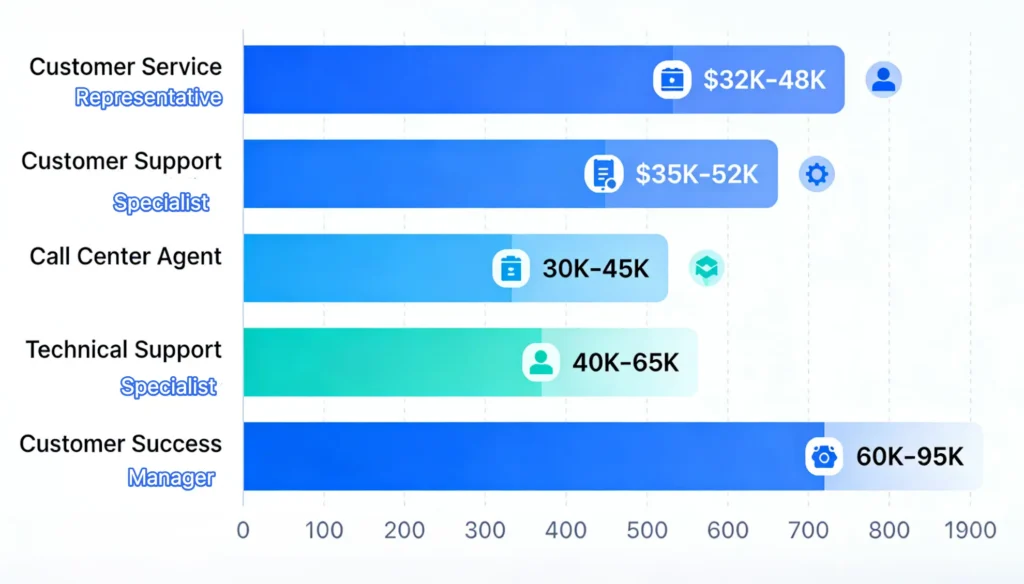
Customer Service Representative: $32K–48K/yr
Frontline position and direct response to customer queries, orders, and basic troubleshooting on the phone, email, or even online chat. Must have good communication skills, patience, empathy, and expertise in customer service software.
Customer Support Specialist: $35K–52K/yr
Deals with more in-depth or expert challenges, like product support or expert account management. Along with the minimum skills in customer service, he/she needs good skills in problem analysis, product knowledge, and documentation.
Call Center Agent: $30K–45K/yr
Job in a call center setting, where most of the duties often involve large amounts of inbound or outbound calls. Focuses on communication skills via phone, resilience to stress, articulation, and rigid adherence to scripts and procedures.
Technical Support Specialist: $40K–65K/yr
Focuses on the troubleshooting of technical problems of software, hardware, or network. These tasks involve fault problem diagnosis and step-by-step instructions. The required skills are profound technical expertise, logical reasoning, patience, and good explanatory skills.
Customer Success Manager: $60K–95K/yr
A more strategic position, which is aimed at getting customers to get the maximum value of the products or services they buy, attaining long-term retention, and upselling. Needs good relationship-building, project management, data analysis, and consultative communication skills.
For job seekers, check out: https://bossjob.ph/en-us/onsite-job/
For employers, check out: https://employer.bossjob.com/get-started-company
Conclusion
Great customer service is an important aspect of the competitiveness of a company. In the case of business, quality service means better reputation, trust, and long-term development. In the case of job seekers, knowledge and skills in customer service are essential in building and developing a career in the service economy. Visit Bossjob today to quickly hire talent or find new job opportunities.
FAQs
What is customer service representative?
A customer service representative assists customers with questions, concerns, and basic troubleshooting. They act as the first point of contact and help ensure customers feel supported throughout their experience.
What is customer service in BPO?
Customer service in a BPO refers to support operations outsourced to a third-party provider, where representatives handle calls, chats, or emails on behalf of another company.
What is customer service in call center?
Customer service in a call center involves managing incoming and outgoing calls, resolving issues, and guiding customers through solutions in a structured, high-volume environment.