
Special non-working holiday pay in the Philippines not only plays a vital role in defending the legal rights of employees, but it also assists companies in managing employees in line with labor laws and in the management of holiday pay appropriately.
This article aims to give a thorough description of this form of pay, such as definition, calculation guidelines, and persons who are eligible to receive the payment, and allow readers to get a precise idea about it.
What is Special Non-working Holiday Pay?
Pay for special non-working holiday is the payment that employees receive when they go on some non-working holidays. Unlike standard holiday pay, it does not entitle the employee to work on that day, but in the event that the employee works, they are entitled to receive more wages. It aims at protecting the rights of employees on certain holidays and motivating companies to enforce the rules on labor holidays.
Typical holidays in the Philippines include:
- Ninoy Aquino Day
- All Saints’ Day
- Black Saturday
- National Heroes Day
These holidays are considered to be special non-working holidays, and employees who work during such days have the right to get reimbursement for the payment.
Holiday Pay vs Special Non-working Holiday Pay Philippines
While both are types of premium pay for work done on public holidays, regular holidays, and special non-working holidays have distinct pay rules under the Philippine Labor Code.
| Feature | Regular Holiday Pay | Special Non-Working Holiday Pay |
|---|---|---|
| Legal Basis | Prescribed by the Labor Code (Article 94) and specific proclamations. | Declared by presidential or congressional proclamation. |
| Significance | Often of major historical, religious, or national importance (e.g., Independence Day, Christmas Day). | Primarily commemorative, aiming for public observance without major economic disruption. |
| Pay Rate (No Work) | 100% of daily wage, given even if the employee did not work (“No Work, No Pay” principle does not apply). | No premium pay if unworked. The “No Work, No Pay” principle generally applies unless company policy states otherwise. |
| Pay Rate (Did Work) | 200% of daily wage for the first 8 hours. | 130% of daily wage for the first 8 hours. |
| Overtime on the Day | Plus applicable overtime premiums on top of the 200% rate. | Plus applicable overtime premiums on top of the 130% rate. |
In summary, regular holiday pay guarantees that employees who do not work will still receive their salary.Non-special working holiday pay emphasizes “pay for work”.
Special Non-working Holiday Pay Rule in Philippiens
The Philippine Department of Labor and Employment (DOLE) says that pay for special non-working holiday is calculated on the basis of the basic daily wage of the employee.
Working employees on these holidays are entitled to a premium of 30% of their regular wages in addition to their regular salaries (first eight hours), which makes a total of 130 percent of their daily allowances. Any overtime done on the holiday is compensated at an extra premium.

💰Example (Daily Rate = ₱500):
- Worked 8 hours: Base (₱500) + 30% Premium (₱150) = ₱650 total.
- Worked 10 hours (2 hrs OT): Pay for first 8hrs: ₱650. Overtime calculation: Hourly rate (₱62.5) × 125% (OT rate on special day) × 2 hours = ₱156.25. Total Pay: ₱650 + ₱156.25 = ₱806.25.
- Did NOT work: The “No Work, No Pay” principle applies. The employee receives no holiday pay unless company policy or a Collective Bargaining Agreement (CBA) states otherwise.
📚References:
- Philippine Information Agency. DOLE issues pay rules for Dec. 26 special holiday.https://pia.gov.ph/news/dole-issues-pay-guidelines-for-december-holidays/
- PhilStar. DOLE reminds employers: Dec. 8 pay guidelines. https://www.philstar.com/headlines/2025/12/07/2492594/dole-reminds-employers-dec-8-pay-guidelines
- Labor Law PH. Holiday Pay. Updated April 20, 2025. https://laborlaw.ph/holiday-pay/
Who Qualifies for Non-special Working Holiday Pay?
Eligibility is not automatic for all workers and depends on employee classification and specific legal provisions.
- Covered Employees: The employees hired under the private sector, such as the rank-and-file, which encompass regular workers, probationary workers, project-based workers, and seasonal workers, are entitled to premium pay on the day of the holiday.
- Excluded Employees: The labor code excludes the pay rules from applying to managerial employees, confidential employees, personal service providers of an employer, and workers in some retail/service establishments that have fewer than 10 workers.
- Special Provisions: The statutory minimum can be outdone by the internal policy of a company or the legitimate Collective Bargaining Agreement (CBA).
How to Compute Special Non-Working Holiday Pay Philippines?
Follow this step-by-step guide to accurately calculate pay for special non-working holiday.
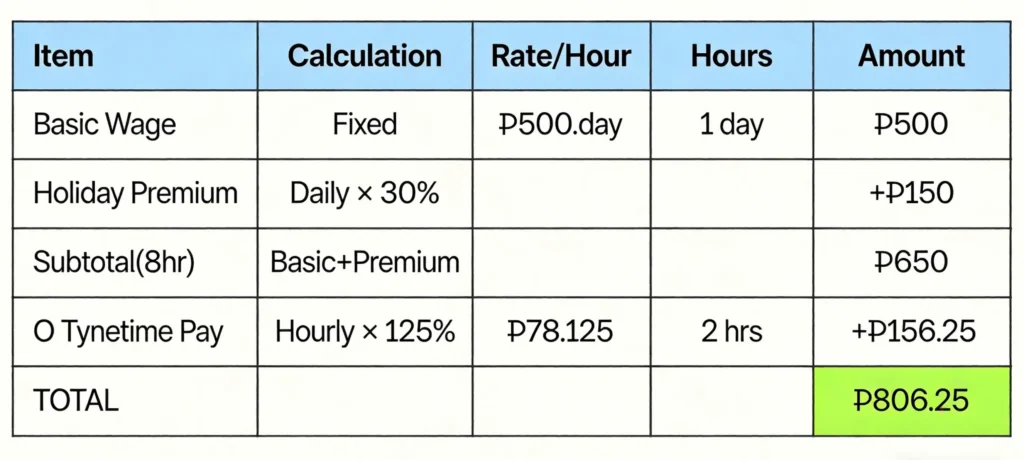
- Determine the Daily Rate: Identify the employee’s basic daily wage (e.g., ₱500).
- Calculate the 30% Premium: Multiply the daily rate by 0.30 (e.g., ₱500 × 0.30 = ₱150).
- Compute Total Pay for First 8 Hours: Add the premium to the daily rate (e.g., ₱500 + ₱150 = ₱650).
- Account for Overtime (if any): Calculate the hourly rate (Daily Rate ÷ 8). For overtime on a special holiday, multiply the hourly rate by 125% to get the OT hourly rate. Multiply this by the number of overtime hours and add to the total from Step 3.
It is also worth mentioning that the final special non-working holiday pay computation must always be checked against the employment contract of the individual, company policy, or the CBA in place.
📊For a clearer breakdown of daily wages, check out: https://aisalary.bossjob.com/
Conclusion
The special non-working holiday pay rules in the Philippines will help with the proper payment of payroll. In the case of job seekers and employers, it is possible to use the local recruitment sites such as Bossjob to find the right job or the right employee, and a win-win scenario of holiday pay and labor protection is achieved.
FAQs
Is a special non-working holiday double pay?
No. Work during a special non-working holiday does not entitle the employee to 200% of the daily rate. Instead, employees are generally paid 130% of their daily rate for the first eight hours. Double pay applies only to work performed on regular holidays.
Is non-special working holiday pay taxable?
Yes. Special non-working holiday pay, including the 30% premium, is generally included as part of the employee’s gross taxable income and is subject to withholding taxes in accordance with Philippine tax regulations.
What occurs if a holiday falls on an employee’s scheduled day off?
If a special non-working holiday falls on an employee’s rest day and the employee does not work, the “No Work, No Pay” principle applies, and no premium is paid. If the employee works on that rest day, which also falls on a special holiday, a higher combined premium rate (typically 150% of the daily rate) may apply in accordance with DOLE guidelines.